Structural elements are widespread across genomes, but their complexity and role in repeatedly driving local adaptation remain unclear. In this work, we use phased genome assemblies to show that adaptive divergence in cryptic color pattern in a stick insect is repeatedly underlain by structural variation, but not a simple chromosomal inversion. We found that color pattern in populations of stick insects on two mountains is associated with translocations that have also been inverted. These translocations differ in size and origin on each mountain, but they overlap partially and involve some of the same gene regions. Moreover, this structural variation is subject to divergent selection and arose without introgression between species. Our results show how the origin of structural variation provides a mechanism for repeated bouts of adaptation.
Deep-tissue transcriptomics and subcellular imaging at high spatial resolution
Limited color channels in fluorescence microscopy have long constrained spatial analysis in biological specimens. We introduce cycle hybridization chain reaction (cycleHCR), a method that integrates multicycle DNA barcoding with HCR to overcome this limitation. cycleHCR enables highly multiplexed imaging of RNA and proteins using a unified barcode system. Whole-embryo transcriptomics imaging achieved precise three-dimensional gene expression and cell fate mapping across a specimen depth of ~310 μm. When combined with expansion microscopy, cycleHCR revealed an intricate network of 10 subcellular structures in mouse embryonic fibroblasts. In mouse hippocampal slices, multiplex RNA and protein imaging uncovered complex gene expression gradients and cell-type–specific nuclear structural variations. cycleHCR provides a quantitative framework for elucidating spatial regulation in deep tissue contexts for research and has potential diagnostic applications.
材料科学Materials Science
Perfect Coulomb drag and exciton transport in an excitonic insulator
Strongly coupled electron-hole bilayers can host quantum states of interlayer excitons, such as high-temperature exciton condensates at zero magnetic field. This state is predicted to feature perfect Coulomb drag, where a current in one layer is accompanied by an equal but opposite current in the other. We used an optical technique to probe the electrical transport of correlated electron-hole bilayers based on MoSe2/hBN/WSe2 heterostructures. We observed perfect Coulomb drag in the excitonic insulator phase at low temperatures; the counterflow resistance of interlayer excitons remained finite. These results indicate the formation of an exciton gas that does not condense into a superfluid. Our work demonstrates that dynamic optical spectroscopy provides a powerful tool for probing exciton transport behavior in correlated electron-hole fluids.
Fatigue of Li metal anode in solid-state batteries
Solid-state lithium metal batteries (SSBs) are promising for electric vehicles because of their potential to provide high energy density and enhanced safety. However, these batteries face short-circuit challenges caused by uncontrolled lithium dendrite growth during cycling. Using operando scanning electron microscopy and phase-field simulations, we determined that failure of SSBs is closely linked to the fatigue of the lithium metal anode, which markedly contributes to interface degradation and dendrite growth in SSBs. This fatigue follows the Coffin-Manson equation in mechanics, indicating that it is an innate characteristic. Clarifying the essential role of fatigue provides a physical basis for understanding failures of SSBs and paves the way to extending their lifespan.
天文学Astronomy
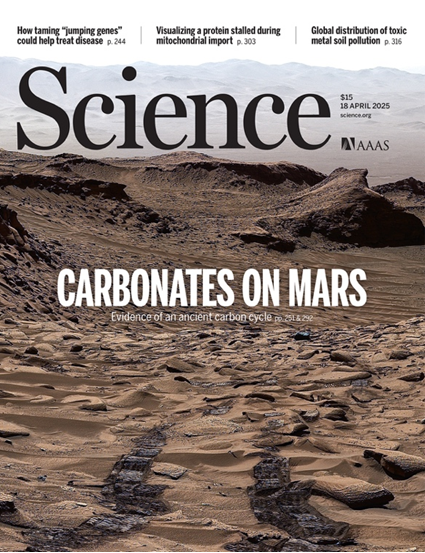
Carbonates identified by the Curiosity rover indicate a carbon cycle operated on ancient Mars
“好奇号”火星车探测到的碳酸盐矿物表明古代火星存在碳循环
▲ 作者:Benjamin M. Tutolo, Elisabeth M. Hausrath et al.
Ancient Mars had surface liquid water and a dense carbon dioxide (CO2)–rich atmosphere. Such an atmosphere would interact with crustal rocks, potentially leaving a mineralogical record of its presence. We analyzed the composition of an 89-meter stratigraphic section of Gale crater, Mars, using data collected by the Curiosity rover. An iron carbonate mineral, siderite, occurs in abundances of 4.8 to 10.5 weight %, colocated with highly water-soluble salts. We infer that the siderite formed in water-limited conditions, driven by water-rock reactions and evaporation. Comparison with orbital data indicates that similar strata (deposited globally) sequestered the equivalent of 2.6 to 36 millibar of atmospheric CO2. The presence of iron oxyhydroxides in these deposits indicates that a partially closed carbon cycle on ancient Mars returned some previously sequestered CO2 to the atmosphere.
 書籍詳情
書籍詳情






 43734
43734 51
51










 加入書架
加入書架  開始閱讀
開始閱讀  目錄
目錄